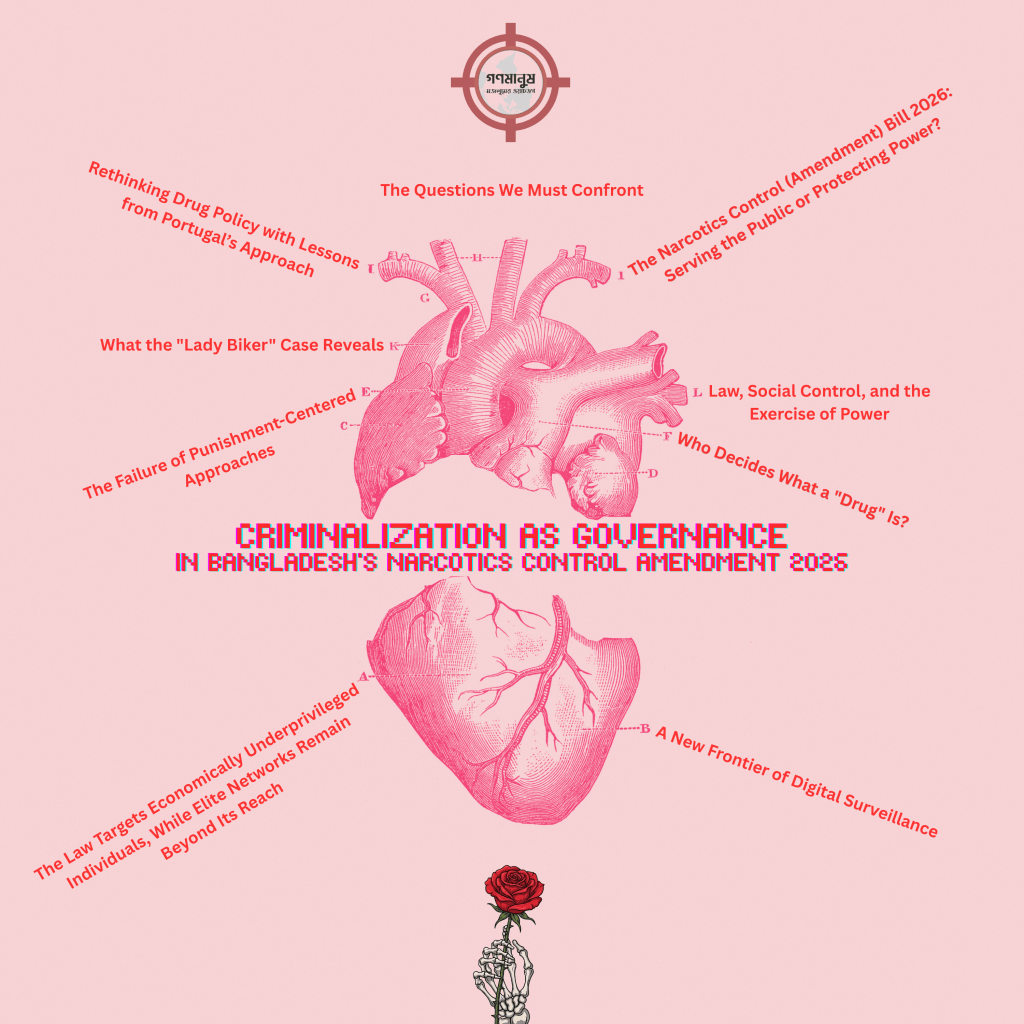
Opinion + Visual by Faysal Zaman
The Narcotics Control (Amendment) Bill 2026: Serving the Public or Protecting Power?
The Narcotics Control (Amendment) Bill 2026 should not be seen only as a law against drug crime. It is also part of a bigger change in how the state controls society and people’s everyday lives. This new law gives the state more power. It does not just punish crime, it also decides which behaviors are “normal” and which are “wrong,” and draws the line between the two.
Who Decides What a “Drug” Is?
A drug is not automatically illegal because of its chemical nature. It becomes illegal through history, culture, politics, and the choices of those in power. So banning drugs is not just a simple answer to a public problem. It is a way for the state to create moral rules, decide what counts as a crime, and build systems of control.
This means drug policy does not only control criminal acts. It also controls people’s bodies, choices, and daily lives. The real question is not only “which drugs are banned,” but also “which groups of people get treated as dangerous.” Through watching and labeling people, drug law can turn ordinary citizens into targets of state control.
What the “Lady Biker” Case Reveals
The story of Irin Jahan Esha Sheikh, known as the “Lady Biker,” shows this clearly. LGBTQI+ rights groups and JusticeMakers Bangladesh in France (JMBF) say Esha was falsely linked to a drug case. They believe the real reason was her identity as a lesbian, after she stepped in to stop her partner’s family from forcing the two apart and sending her partner to a rehab center. JMBF says there was no real proof of a crime, only discrimination against her sexuality, and they are demanding an independent investigation.
Whether or not the charges are proven true, the case shows something important: a drug law, which is supposed to be about substances, can be used as a tool to punish someone simply for who they love.
The Law Targets Economically Underprivileged Individuals, While Elite Networks Remain Beyond Its Reach
In Bangladesh, drug law also shows deep class inequality. The people usually caught and punished are small users, low-level carriers, and poor communities, the weakest people in the drug trade. Meanwhile, the big money networks and political connections that run large-scale trafficking are rarely investigated or punished. This is a common pattern: the justice system often punishes the weak while leaving the powerful structures untouched.
Two real cases make this clear. On 19 May 2017, security forces arrested 28 young men at a gathering of more than 150 people in Keraniganj. They were charged with drug possession under the Narcotics Control Act 1990. Not because of any real investigation into a trafficking network, but simply because they were at that gathering. This shows how the law can be used as a blunt tool of control, rather than a fair response to real crime.
A similar thing happened to a boy called Ahan (not his real name). According to UNICEF, he was arrested at just seventeen while spending time with friends. He had nothing to do with drugs. He was falsely charged, held for months, and the case damaged his education, his reputation, and his mental health. His story shows how children, not just adults, can be caught up in this system sometimes only because of where they were standing, or because an officer suspected them.
So, punishing people harshly does not necessarily destroy the drug trade. Instead, it can repeat and strengthen existing unfairness in society, by putting the heaviest punishment on the weakest people.
A New Frontier of Digital Surveillance
The amendment also reaches into the digital world. It brings online messages, internet platforms, digital payments, and virtual assets under narcotics law. Fighting online crime is a fair goal. But this expansion also raises hard questions: How much power is too much? Who checks that the power is used fairly? Without strong safeguards, wide legal powers can lead to unfair targeting, unclear rules, and constant surveillance becoming normal.
Bangladesh has faced this problem before. Section 57 of the Information and Communication Technology Act, 2006, and later the Digital Security Act, 2018, were both misused. Vague wording in these laws was used against journalists, activists, and critics, far beyond what the laws were originally meant for. The anti-narcotics campaign that started in 2018 showed the same pattern: harsh punishment fell mostly on poor, low-level offenders, while concerns about fair trials and violence outside the law grew louder. Together, these examples show a clear warning: when laws give too much power without enough oversight, they can end up reshaping the relationship between the government and its own citizens, not just fighting crime. The new amendment raises the same worry for the online world: without clear rules, ordinary citizens could be unfairly targeted.
Rethinking Drug Policy with Lessons from Portugal’s Approach
Punishment is not the only way to handle drug problems. In 2001, Portugal made a bold choice: it stopped treating personal drug use and possession as a crime, and started treating it as a health issue instead. People found with small amounts of drugs are sent to special health panels, which offer treatment, counseling, and support, not prison. Selling and producing drugs are still crimes. But this change, along with strong investment in healthcare and support services, has led to fewer overdose deaths, less spread of HIV and Hepatitis C, and less crowding in prisons.
Portugal’s success did not come from decriminalization alone. It came from also building a strong healthcare and support system. Instead of treating addiction as a personal failure to be punished, Portugal treated it as a health problem to be solved with care and treatment. This proves that tougher punishment is not the only path to a safer society.
The Failure of Punishment-Centered Approaches
Bangladesh still relies heavily on harsh punishment, including the death penalty for some drug crimes. But this raises a fair question: is punishment alone actually working? When strict laws fail to stop the drug trade, the real problem may not be that the laws are not harsh enough. It may be that deeper issues remain unsolved. The drug trade is tied to poverty, unemployment, corruption, weak institutions, and political protection. Focusing only on visible street-level crime, while ignoring these deeper causes, risks creating endless punishment without real solutions.
The cases of Esha, the 28 young men from Keraniganj, and Ahan are not rare mistakes in an otherwise fair system. They are the natural result of a system built mainly on punishment, where power is expanded without enough responsibility attached to it.
Law, Social Control, and the Exercise of Power
This new law is also appearing at a time when conservative political ideas about morality and social order are growing stronger. In this climate, laws can become tools for pushing a particular vision of “acceptable” behavior, not just fighting crime. Esha’s case shows this well: it is not only about unfair punishment, but about how drug law can be used to control private relationships and identities that fall outside what society considers “normal”, all under the cover of a law that seems, on paper, to be about something else entirely.
This connects to a bigger idea: powerful social values get repeated and reinforced through institutions, including the legal system. Law does not just reflect society, but it actively shapes how people think about danger, morality, and who belongs. By deciding which behaviors count as “threats,” the law influences who get watched, and who gets left alone.
The Questions We Must Confront
The real question about this amendment is not simply whether the state has the right to punish people. It is about how that power is used, who benefits from it, and what kind of society it creates. A safer society cannot be built only by expanding punishment, while leaving the root causes of addiction, trafficking, and vulnerability unaddressed.
Without tackling inequality, weak institutions, and the political systems that protect the drug trade, tougher laws risk becoming less about protecting the public and more about control and exclusion. A better path forward would invest in real solutions: accessible addiction treatment, harm reduction programs, mental healthcare, and support for people to rebuild their lives. At the same time, the government should strengthen accountability, protect fair trials, and focus law enforcement on real trafficking networks, not on vulnerable individuals.
The stories in this piece, a woman allegedly targeted for who she loves, 28 young men swept up at a party, a child wrongly accused, and a long history of laws being misused, all point to the same truth. The success of drug policy should not be measured by how harshly it punishes people. It should be measured by how well it protects public health, ensures justice, and respects the rights and dignity of every citizen.
References:
1. Bangladesh’s Expanding Narcotics Law and Digital Criminalization
Source: The Daily Star – “Online drug trade can draw death penalty under new law”: https://www.thedailystar.net/news/the-parliament-watch/parliament/news/online-drug-trade-can-draw-death-penalty-under-new-law-4222986
2. LGBTQI+ Rights, Criminalization, and the Misuse of Drug Laws
Source: JusticeMakers Bangladesh in France (JMBF) – Public Statement on the “Lady Biker” Case: https://www.jmbf.org/2025/04/press-public-statement-jmbf-condemns.html
3. Bangladesh’s Drug War and Human Rights Concerns
Source: Amnesty International – “Bangladesh: ‘No Place for Human Rights’: The Crackdown on Drugs”: https://www.amnesty.org/en/documents/asa13/6305/2017/en/
4. Portugal’s Drug Decriminalization: A Health and Human-Centered Alternative
Source: Drug Policy Alliance – “Drug Decriminalization in Portugal: Learning from a Health and Human-Centered Approach”: https://drugpolicy.org/wp-content/uploads/2023/08/dpa-drug-decriminalization-portugal-health-human-centered-approach_0.pdf
5. Global Drug Policy Reform and Alternatives to Punitive Approaches
Source: Global Commission on Drug Policy: https://globalcommissionondrugs.org/
6. Coloniality of Power, Knowledge, and the Production of Social Hierarchies
Source: Aníbal Quijano – Coloniality of Power, Eurocentrism, and Latin America: https://www.decolonialtranslation.com/english/quijano-coloniality-of-power.pdf
7. Gender, Identity, and the Social Construction of Norms
Source: Judith Butler – Gender Trouble: Feminism and the Subversion of Identity (1990): https://monoskop.org/images/e/ee/Butler_Judith_Gender_trouble_feminism_and_the_subversion_of_identity_1990.pdf
8. Digital Surveillance and the Expansion of Data-Based Power
Source: Shoshana Zuboff – The Age of Surveillance Capitalism (2019): https://we.riseup.net/assets/533560/Zuboff%2C+Shoshana.The+Age+of+Surveillance+Capitalism.2019.pdf
9. Punishment, Poverty, and the Criminalization of Vulnerable Communities
Source: Loïc Wacquant – Punishing the Poor: The Neoliberal Government of Social Insecurity: https://www.dukeupress.edu/punishing-the-poor


Leave a Reply